
Sub-Total: $0.00

When Expectations Fall Short: Turning Disappointment Into Opportunity
What do you do when someone lets you down? Do you lean in—or pull back?
We’ve all been there—when someone doesn’t meet our expectations. Maybe it’s a colleague who dropped the ball, a direct report who missed a deadline, or a partner who didn’t follow through. In those moments, our instinct is often to pull back, rationalize, or quietly adjust our expectations to avoid conflict.
But what if the real growth, for both people, in those moments depends on courage instead of comfort?
The Cost of Silence
When we hold back our truth, we often tell ourselves it’s because we don’t want to hurt feelings or create tension. But underneath that restraint usually sits fear: fear of rejection, fear of judgment, or fear of being misunderstood.
As a coach, I’ve seen this pattern play out in leaders at every level. They avoid hard conversations to preserve harmony, but the silence slowly erodes trust and clarity. The very thing they’re trying to protect—the relationship—starts to weaken.

Our unspoken truths become invisible barriers that shape how we lead, connect, and perform.
How Has That Approach Served You?
It’s a powerful question. When you’ve softened your message or withheld feedback, how did it serve you or the other person? Did the performance improve? Did trust deepen? Did clarity grow?
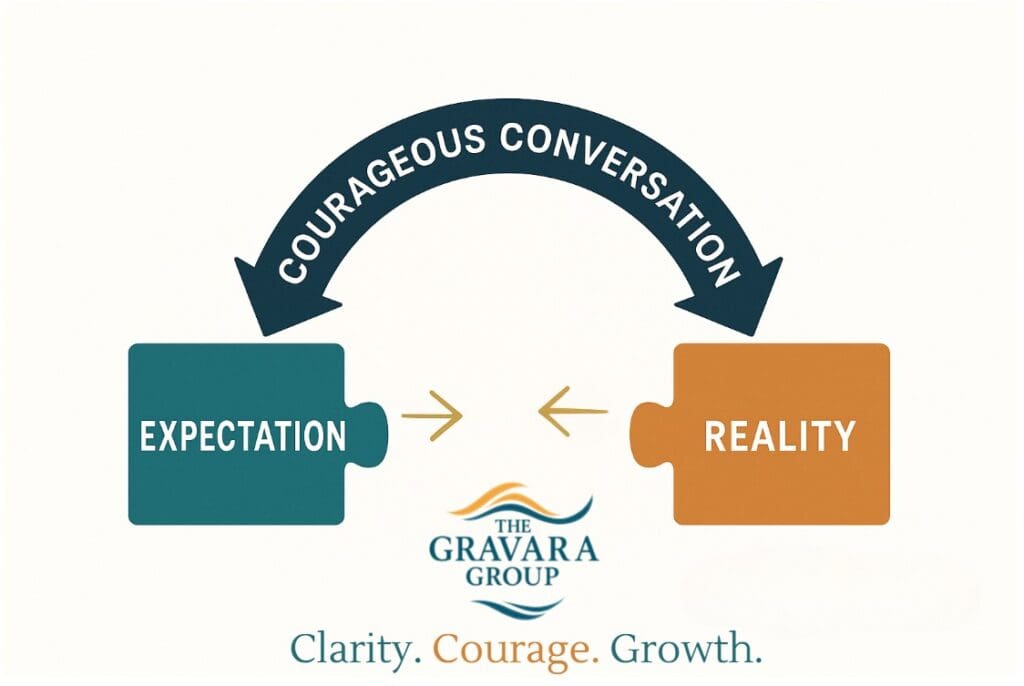
Most often, the answer is no. Instead, resentment builds quietly. Energy drains. And the gap between expectation and reality widens.
Reframing the Moment
What if unmet expectations aren’t failures, but pivotal opportunities?
Opportunities to clarify what matters.
Opportunities to reconnect with values and vision.
Opportunities to model courageous communication that invites—not demands—change.
And sometimes, these moments open the door to something even more powerful: the chance to redesign the relationship.
When we approach disappointment with curiosity instead of criticism, we can reset expectations and co-create new agreements about how we’ll work together. It becomes a collaborative redesign—one that honors what both parties need to feel supported, respected, and aligned moving forward.
Instead of simply “fixing” what went wrong, we reimagine what could be better.
From Disappointment to Development
In my experience, leaders who master this shift become catalysts for transformation. They learn that expectations aren’t just standards, they’re invitations. Every missed mark is a mirror reflecting where alignment is needed.
Transparency, handled with empathy, becomes the bridge between performance and trust.
So next time someone doesn’t meet your expectations, pause before pulling away. Consider leaning in with clarity, compassion, and courage. That’s where real leadership begins and where relationships evolve into something stronger, truer, and more fruitful.
Check out more resources at: www.thegravaragroup.com
To schedule a complimentary discovery call, email jennifer@thegravaragroup.com
