Sub-Total: $0.00
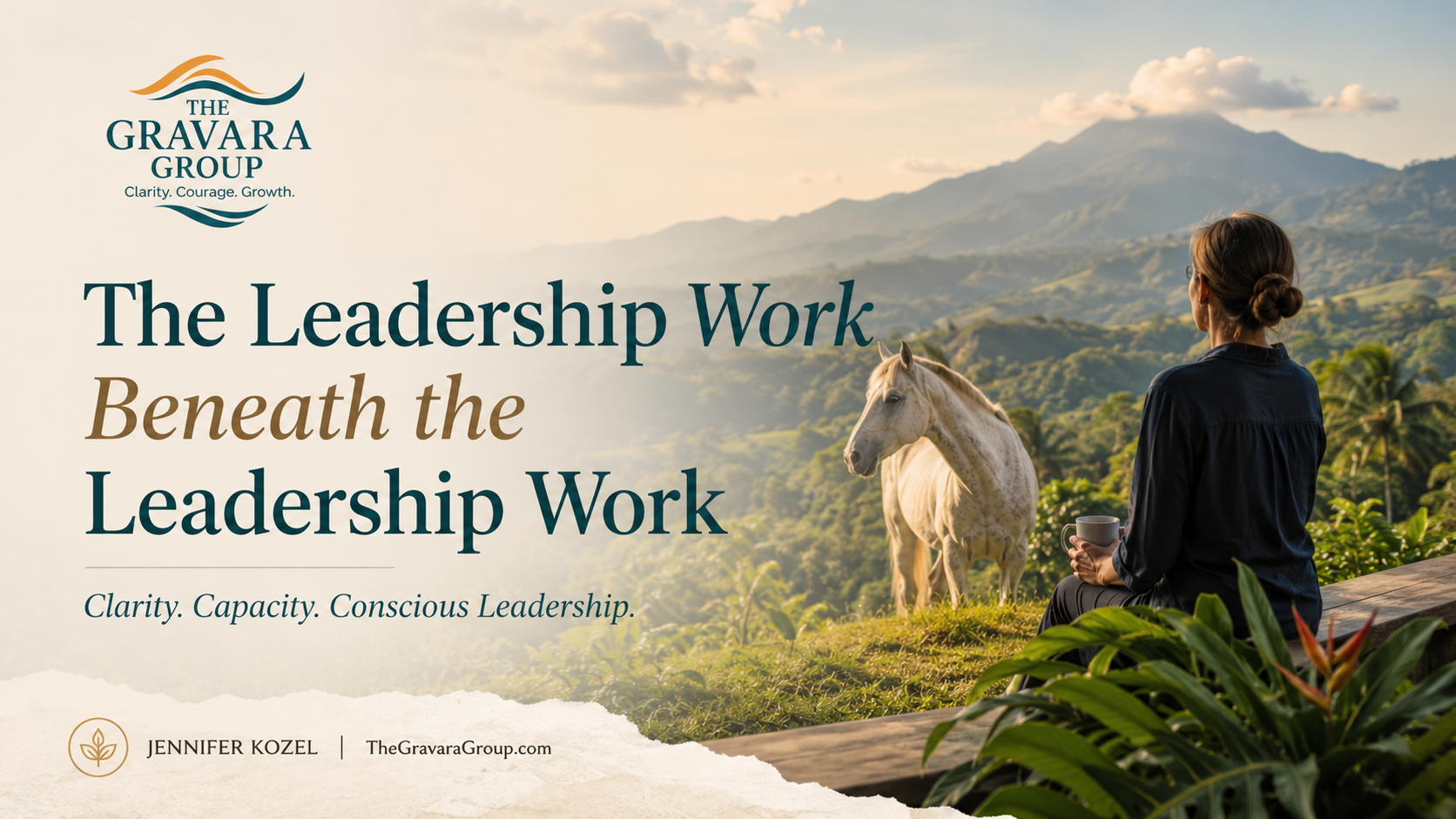
The Leadership Work Beneath the Leadership Work
By Jennifer Kozel, Founder, Executive Coach, & Fractional CHRO
There is a point in many executives’ careers when the very things that made them successful start to get in the way.
✓ The drive.
✓ The decisiveness.
✓ The ability to carry pressure.
✓ The instinct to solve the problem before anyone else can.
Those qualities are often the reason a leader has gotten as far as they have.
But I have watched this happen over and over again: the same patterns that helped a leader rise eventually start to create friction.
The leader who can carry everything keeps carrying too much.
The leader who can make fast decisions stops leaving enough room for others to think.
The leader who has high standards starts creating pressure without realizing it.
The leader who is used to being strong forgets that leadership also requires being reachable.
And because most executives are still performing well, very few people around them say anything. The results, title, and credibility are still there, but something feels different.
Heavier. Tighter. Less clear.
That is usually where the deeper work begins.
The external work is not always the answer
In my HR career, I have spent a lot of time inside the practical side of business.
✓ Org structure.
✓ Talent strategy.
✓ Accountability.
✓ Culture.
✓ Change.
✓ Executive alignment.
✓ M&A integration.
✓ Leadership development.
The things that most people think about when considering how organizations work, or not work.
I believe in the importance of that work.
But I also know this:
- Sometimes the structure is not the real constraint.
- Sometimes the strategy is not the real constraint.
- Sometimes the team is not even the real constraint.
Sometimes the real constraint is the leader’s internal operating system.
The deeper work is in how a leader relates to control, how they handle conflict, and how much truth they can tolerate in the room. It shows up in their comfort with silence, their instinct to move quickly into rescue mode, and the quiet ways their identity may have become tied to being needed. It also shows up in how often over-functioning gets dressed up as commitment, when underneath it may really be a pattern of carrying what was never meant to be carried at all. That is the leadership work beneath the leadership work.
The opportunities for this work show up in meetings, decision-making, and in what people are willing to say out loud. It shows up in whether a team takes ownership or waits to be told.
And it shows up in whether a leader creates clarity or unintentionally creates dependency.
At senior levels, leadership is not just about what you know or what job title you hold. It is about who you become under pressure.
Capacity is not just a calendar issue
When leaders tell me they’re at capacity, they usually mean their calendar is packed. Too many meetings, too many decision points, too many people needing something, and too many things marked urgent that may or may not actually be important. And that is real. Most executives are carrying more than is sustainable.
But leadership capacity is not just about time. It is also about the leader’s ability to stay grounded when the room gets tense. To listen without immediately fixing. To hold authority without needing to control every outcome. To make a hard decision without becoming hard in the process. To be challenged without becoming defensive.
That kind of capacity does not come from another productivity hack. It comes from slowing down long enough to notice what is happening inside of you while everything around you is demanding a response. That is where leadership starts to shift from reacting to actually leading.
It comes from space, reflection, honest feedback, and a willingness to look at what is truly happening beneath the surface.
Most leaders just need to hear what they already know inside, but don’t freely acknowledge.
The hidden ceiling of successful leaders
One of the patterns I see most often is that a leader reaches a new level of responsibility, but keeps leading from an old level of identity.
✓ The fixer.
✓The rescuer.
✓The protector.
✓The driver.
✓The expert.
✓The one who always knows.
✓The one who never needs anything.
Those identities can be useful for a season. Sometimes they are even necessary. Many leaders developed them honestly because something in their life or career required it. They learned how to carry more, solve faster, stay composed, absorb pressure, and keep moving.
But those identities are not meant to become cages.
The leader who has always been the fixer may struggle to build a team that truly owns the work. The leader who has always been the driver may not realize how much pressure others feel in their presence. The leader who has always been the expert may unintentionally shut down the wisdom in the room. And the leader who has always been the strong one may have no idea how lonely their leadership has become.
None of this makes the leader wrong. It simply means the next season is asking something different from them.
That is the part we often miss in leadership development. We keep trying to add more skills, more tools, more models, and more language. Sometimes those things help. But sometimes the real work is not adding something new. Sometimes the real work is releasing the pattern that has gotten too small for where the leader is going.
What horses have taught me about leadership
Some of the most honest leadership feedback I have ever seen has not come from a boardroom, a 360, or a performance review.
It has come from horses.
That may sound strange if you have never experienced it, but horses are remarkably honest mirrors. They do not care about your title, how polished your resume is, or if you are used to being the one in charge. They scan your body, your presence, your electromagnetic field, and they your emotional state. They respond purely to who you are in that moment.
If you are unclear, they react to that. If you are trying too hard, they often make it more difficult for you. If you are disconnected from yourself, they show you that.
They don’t judge any of it. They simply respond to how you show up – on the inside as well as the outside.
That is what makes the work so powerful. I have watched leaders realize, in a matter of minutes, that what they thought was calm was actually control. What they thought was clarity was actually pressure. What they thought was confidence was actually tension.
And I have watched that all shift in real time during equine-guided coaching sessions.
The leader stops trying so hard to make something happen. They breathe. They soften. They get present and often look inward. They become clear without pushing. And the horse responds differently.
That moment is hard to explain to someone who has not seen it, but it is unmistakable when you are standing there. The leader feels the difference between force and presence. Between trying to control the outcome and becoming someone worthy of being followed.
The experience is transformative, and the lessons learned are lasting.
Moving from reaction to real presence
In my work with leaders, I often see growth move through a few stages.
First, there is the stage where everything feels like it is happening to the leader.
The team will not step up. The board is too impatient. The culture is too resistant. The market is too difficult. The timing is wrong. The people are not ready.
And some of that may be true.
But when a leader stays there too long, they lose access to choice. They may still be powerful on paper, but internally they begin to lead from frustration, resentment, pressure, or resignation. That is a hard place to create from.
The next shift is ownership.
Not blame. Not shame. Ownership.
The leader starts asking better questions. What am I creating here? What am I tolerating? What am I avoiding? What am I reinforcing? Where have I been waiting for someone else to change before I lead differently?
That is where power starts to return.
Then, if the leader keeps growing, something else becomes possible. They stop relying on effort alone. They listen more. They trust themselves more. They leave more space. They stop confusing urgency with importance. They become less addicted to pushing.
Eventually, the work becomes less about technique and more about embodiment.
The leader becomes steadier. Cleaner. More honest. Less performative. More congruent.
They do not have to announce the change. People feel it and start responding differently.
That is the difference between knowing leadership language and actually living it.
Sometimes you have to step away to see clearly
There is a reason our best insights often come when we are not sitting at our desk.
They come on a walk, in nature, under trees, and when the mind is quiet. In the first real exhale we have allowed ourselves in longer than we care to admit.
A leader’s nervous system cannot access new wisdom from inside the same pressure that created the problem. Sometimes the pace itself is part of what keeps the pattern alive.
That is why stepping away is necessary.
Not stepping away to avoid responsibility, or to escape the hard things waiting back at the office. Stepping away so you can return to your responsibilities with more clarity, more honesty, and more capacity.
When leaders give themselves the right kind of space, they often begin to see things they could not see from inside the noise. They can notice the patterns, become aware of the true cost, and see the choices ahead of them. They can see the version of leadership they have outgrown, and what is trying to emerge next.
And once they see what they are capable of, they usually cannot unsee it.
A few questions worth contemplating
If you are leading at a significant level, here are a few questions I would not rush past:
- Where am I leading from pressure instead of presence?
- Where has control become a substitute for trust?
- Where am I over-functioning and calling it commitment?
- What truth am I avoiding because naming it would require something from me?
- What part of my leadership was once useful, but is now too small for where I am going?
- What would change if I stopped performing strength and started practicing alignment?
These are not easy questions, but they are clarifying ones.
And clarity is usually where courage begins.
The work that changes the room
The deeper leadership work does not make leaders softer in a way that weakens them.
It makes them clearer.
✓ More grounded.
✓ More honest.
✓ More discerning.
✓ More available for the responsibility they carry.
It changes how they enter the room, how they listen, what they tolerate, and what they no longer need to prove.
And because leadership is contagious, it changes what becomes possible for everyone around them.
I still care deeply about strategy, structure, talent systems, accountability, and culture. That work is important and necessary.
But beneath all of it, most importantly, is the leader. The human being in the seat. The one carrying the pressure, the authority, the fear, the wisdom, the fatigue, the vision, and the possibility. That is where the most important work lives.
The leadership work beneath the leadership work.
It is the most meaningful work I know how to do.
At The Gravara Group, this is the space we create: clarity beneath complexity, courage beneath performance, and growth that is not only strategic, but deeply human.
